
By Vedanti Hindurao
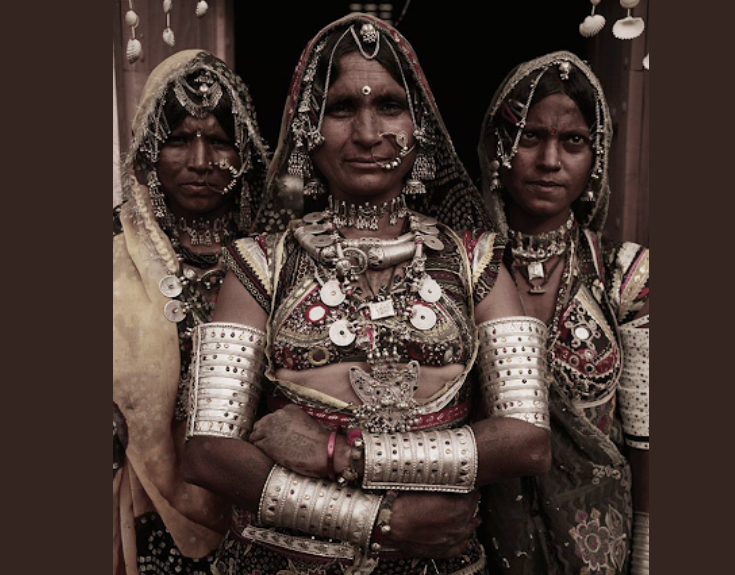
Adornment—whether in the form of jewellery, textiles, or bodily decoration—has long been intertwined with expressions of identity, status, and desire. In Rajasthani women’s folk songs, ornaments do not merely function as material objects but emerge as active participants in narratives of love, loss, defiance, and aspiration.

These lyrics blur boundaries between the affective and the societal, often carrying multiple meanings that shift depending on context. Rather than situating ornaments within a strict dichotomy of ritualistic-symbolic vs. social-structural significance, this essay explores how these folk songs engage with adornment as a site of simultaneous meaning-making—one that can affirm tradition while also subtly resist it.
Before turning to the analysis of specific songs, it is important to distinguish between two key modes of influence—affective and societal— informing the significance of ornaments in folk culture. The affective refers to the realm of emotions, memories, and personal desire. A necklace may be longed for as a token of affection from a distant lover, or remembered as the last gift from a now-absent husband. It is in this register that jewellery becomes entangled with longing, intimacy, or grief—often conveyed through poetic and metaphorical language.
By contrast, societal influence pertains to the social codes, hierarchies and expectations that determine who wears what, when, and why. Here, ornaments are indicators of caste, class, marital status, and regional identity—regulating a woman’s place within the domestic and public spheres. A gold nose ring might mark an upper-caste Rajput woman, while the absence of such adornment in another might speak to economic precarity or caste-based exclusion. While these two registers often overlap, their interplay in folk songs creates space for both compliance and critique, ritual and resistance.
Through an analysis of selected folk songs, this essay will examine how jewellery and clothing serve as emotional registers and markers of societal expectations, revealing the nuanced ways women negotiate their roles through songs.
Seasonal Temporality and Aesthetic Demand: Adornment as Emotional Currency and Material Wealth
Song 1: समदरियो (The sea is swaying with waves)
‘माथा ने मैमद, ल्याओ रंग रसिया।
म्हारी रखड़ी रतन जडाइजो सा बालमा॥
समदरिया लहरा लेवे सा ओ बालमा।
पिछोला झोला खावे सा ओ बालमा॥’
(Bring me a vibrant headband, O beloved Rasiyo (lover).
Adorn my rakhdi with precious jewels, O my beloved.
The sea is swaying with waves, O beloved.
Even Lake Pichhola begins to sway, O beloved.)
The reference to ‘समदरिया लहरा लेवे’ (the sea rising with tides) and ‘पिछोला झोला खावे’ (Lake Pichhola swaying with waves) signals the arrival of monsoon, a period that transforms the landscape and brings with it a sense of renewal. In Rajasthan, where much of the year is marked by arid conditions, the monsoon is more than just a change in weather—it is a time of abundance, fertility, and festivity.
The monsoon also brings a shift in social life. It is the season of Saawan (monsoon), when women return to their maternal homes, when festivals like Teej celebrate feminine desire and devotion, and when community gatherings are at their peak. The song, therefore, is embedded in a seasonal temporality, where the demand for adornments is not random but tied to a cultural moment of festivity, gathering, and heightened aesthetic display.
The line ‘म्हारी रखड़ी रतन जडाइजो सा बालमा’ (adorn my rakhdi with jewels, my beloved) is crucial. The rakhdi is a forehead ornament traditionally worn by Rajput women, often crafted in gold and embedded with precious stones. It is a marker of status, lineage, and marital identity. But in this song, it is not simply a decorative item—it is a token of remembrance, love and conjugal obligation.
Here, the woman enacts the “demanding wife” trope found in many Rajasthani folk songs, where women assert desire that is both material and emotional. However, this demand is not strictly a plea for wealth but for recognition and remembrance. In folklore, such demands function as a playful assertion of agency. Their articulation of desire through song becomes a subtle way of asserting power within the intimate sphere—a form of relational power that seeks acknowledgement, emotional labour and responsiveness from men who are otherwise structurally privileged.
This form of power is inter-relational in the sense that it does not aim to overthrow the patriarchal structure but to negotiate within it– To be seen, remembered and materially valued by the man who controls access to adornment, and by extension, to social visibility.
By asking her husband to bring her an ornament, the woman in the song is not just requesting an object but situating herself within a network of social and material exchanges. The formal, playful ‘request’ teeters on being a demand that is both socially and patriarchically acceptable. The demand is seasonal and socially embedded—monsoon is a time of renewal, and the act of gifting adornments during festivals is a form of reaffirming relationships, obligations and emotional bonds. Just as the monsoon revives the land, the arrival of a gifted ornament revives and reaffirms relational bonds.
Moreover, the ornament in question is not just an emotional token, it is also a form of material security. Historically, jewellery has been one of the few forms of wealth women in patriarchal societies like Rajasthan were permitted to own and pass down generationally. It constitutes a rare pocket of economic autonomy within a system where property, land and money has traditionally almost always been directly inaccessible to them. By asking for a rakhdi, the woman is not only seeking recognition but also raising her social status and tangible capital. In a world where inheritance laws and financial decisions remain largely male-dominated, ornaments function as gendered currency– the portable, wearable assets that can be used, remembered, gifted or saved. Her demand, then, is not frivolous; it is a negotiation for emotional and material recognition within the intimate economies of love, lineage and survival.

Female Gaze, Ornamentation and the Politics of Visibility
Song 2: नैना रा लोभी (My eyes are yearning for you)
‘ए-जी, हा सा म्हारी सासु सूती तो नंदन जागे सा
नैना रा लोभी की कर आऊं सा
बाईसा रा बीरा की कर आऊं सा’
ए-जी, हा सा म्हारी रुनक-झुनक पायल बाजे सा
नैना रा लोभी की कर आऊँ सा
(Oh, listen — my mother-in-law sleeps while Nandan is awake.
My eyes are yearning (to see you), but how do I come to you?
My sister-in-law’s brother (i.e., my lover), how do I come to see you.
O dear, my anklets chime with a soft, musical jingle —
How will I come to see you even when my eyes are yearning for you?)
This song paints an intimate but claustrophobic domestic space, where the mother-in-law and the husband’s younger sister represent structures of surveillance. The mother-in-law (सासु), a traditional figure of authority in Rajput and Rajasthani households, dictates the acceptable codes of femininity and adornment. The sister-in-law, despite being younger, remains awake while the mother-in-law sleeps— signifying a layered structure of marital and kinship surveillance that extends beyond elder women’s control. The woman’s lament (“नैना रा लोभी की कर आऊं सा”) suggests that her own gaze is restrained, although, she desires to see and adorn but the house’s social order does not permit it.
This idea of the gaze connects directly to that of ornamentation. Jewellery, particularly for married women, is meant to be displayed yet also controlled. Women are adorned to be seen, yet their desires must remain unseen. The presence of ornaments signifies status, but the desire of longing for beauty or looking outside the domestic sphere is policed. Here, the veil plays a critical role in the tensions between visibility and erasure. As both a physical and symbolic barrier, it marks the woman’s compliance with ideals of laaj (honor/modesty) and caste-gender boundaries. Even as she wears ornaments that draw attention—gold glinting on her forehead, bangles clinking with each step, her visibility is regulated through layers of cloth and silence. The veil is not merely a symbol of and a tool for achieving modesty; it paves the way for spatial codification of who may see, who may be seen, and under what conditions either could take place. Within this paradox, we see how ornamentation becomes a double-edged practice: it embellishes the body while marking it as a site to be morally and physically contained.

Here, the female gaze is denied the agency that ornamentation role inherently possesses. A married woman might be given a nose ring, bangles or anklets, but she is not given the right to gaze freely upon the world or to seek beauty beyond her prescribed role.
The sound of anklets is often an evocative motif, carrying multiple layers of meaning. On the surface, anklets (पायल) symbolize beauty, festivity, and femininity, but they also serve as aural markers of gendered control. Their sound is not neutral—it signals a woman’s presence, regulating her movements in both domestic and public spaces. In many upper-caste (especially, Rajput) cultural traditions, women’s visibility is deeply tied to notions of honor and ‘laaj’ (लाज, modesty). The jingling of anklets, while associated with youthful grace, also complicates a woman’s ability to move discreetly, making her presence constantly perceptible to others. The contradiction lies in the fact that while ornaments are meant to enhance a woman’s beauty, they also increase her social audibility, making her body a site of both admiration and surveillance. In highly stratified social structures, where caste and gender hierarchies dictate movement, the sound of anklets becomes a sonic marker of a woman’s place within these systems.
Bourdieu’s (1979) concept of symbolic power and cultural capital helps illuminate why the sound of ornaments is not just aesthetic but deeply political. The audibility of female movement ensures that women do not move unnoticed, thus enforcing gendered spatial discipline. This gendered regulation of sound is not only about caste hierarchy but also about the separation of public and private spaces. This song grounds itself in traditions of elite/upper-caste households where women are confined to the zenana (inner quarters), while lower-caste women, particularly labouring women, move more freely but at the cost of their social “dignity”. Their lack of ornamentation, or their substitution of silver for gold, is a signifier of both economic and symbolic exclusion. The absence of sound, then, is as significant as its presence—it denotes a lack of financial access, silencing and stripping away of cultural capital as well.
Labour, Sacrifice and the Sociality of Ornaments
Song 3: चरखा (Spinning Wheel)
‘बाराह बरस सॅूं आ आ आ
बाराह बरस सॅूं कामद आयो,
कईं कईं चीजां लायो
अजी हाथ में होकलियो लायो,
चना चाबतो आयो
चरखे री कमाई हो
अजी चरखे री कमाई मे मैं तो नन्दल ने परणाई
नन्दल ने परणाई मैं तो हिवड़े हार गवाई
बला रे, बला रे
औ बला रे भूमर चरखा भू
म्हारे घर जियो मालिक तू
म्हारी नथड़ी रो मोती तू
बला, भूमर चरखा भू’
(He came after twelve long years,
He came after twelve years, this beloved of mine,
Brought many things with him—
A hookah in hand, chewing on roasted gram.
All this from the earnings of the spinning wheel.
From the spinning wheel’s earnings, I married off my sister-in-law.
Married off my sister-in-law, but I also lost my necklace.
Oh, the spinning wheel turns.
You (the spinning wheel) are the master of my house.
You are the pearl of my nose ring.
Oh, the spinning wheel turns.)
The song opens with ‘बाराह बरस सॅूं कामद आयो—“After twelve years, my husband has returned.” This immediately establishes a sense of prolonged wait; a recurring theme in Rajasthani women’s folk songs, where women sing of separation from their lovers, husbands, or brothers. The reference to twelve years suggests not just a long period of absence but a symbolic threshold—a time long enough for the relationships, economies and emotions to have shifted.
The opening lines set the tone of longing and expectation. The husband has returned after twelve years, and the anticipation of reunion is intertwined with the expectation of gifts— perhaps a rakhdi, a necklace or bangles, as seen in other folk songs. However, the only things he brings are a hookah and roasted grains—items for his own indulgent consumption. The woman’s desires—both emotional and material—are disregarded; highlighting a patriarchal economy where women’s needs remain secondary.
This moment sharply contrasts with the “demanding wife” trope in earlier songs, where women assert their desires for jewellery as a form of recognition. Here, the disappointment is not just about ornaments but about what their absence signifies—neglect, unreciprocated care and emotional depletion. This introduces the material economy of relationships, where gifts function as more than objects; they are tokens of remembrance, emotional compensation, and social obligation. They represent sustenance, care, and the fulfillment of a promise, even if belated.
A central theme in the song is the contrast between labour and adornment—between the spinning wheel (चरखा) and jewellery (हार, नथड़ी). The woman sacrifices her necklace (हार) to ensure her sister-in-law’s marriage. This juxtaposition reveals how ornaments are not merely symbols of beauty but objects of circulation within the family economy. In the earlier songs, jewellery circulates through acts of gifting and remembrance, symbolising love and agency. Here, however, it moves through acts of sacrifice and necessity, signalling women’s lack of control over their own possessions. And the expectation of the jewellery as being a shared inheritance. The woman’s necklace is not just a keepsake but a resource to be liquidated for familial obligations.
Unlike in the previous songs where the arrival of monsoon brings the possibility of adornment, here the spinning wheel—the instrument of female labour—becomes a counter-symbol to jewellery. It produces wealth, sustains the household and enables rituals like marriage, yet does not grant the labouring woman the right to keep her own ornaments. The refrain “बला रे भूमर चरखा भू” (Oh fate, oh spinning wheel, hum along!) underscores this contradiction—she keeps working but where is her economic-material share?
Women in these songs may lament their losses but they still uphold structures that prioritise male authority over women’s unshackling from the ornamentary expectations. Illustrating how patriarchy is reinforced through both material deprivation and affective bonds obligated by women-folk through generations. Appadurai’s (1986) concept of the “social life of things” helps illuminate the deeper significance of this demand. Appadurai argues that objects—especially luxury goods like ornaments—gain meaning through their movement across different social contexts. They are not just passive commodities but have lives that are shaped by their circulation, exchange, and the meanings ascribed to them in different contexts. In these songs, the rakhdi and the haar are not just possessions, these are mobile objects that link individuals across space and time, framing the individual in a socio-economic and cultural context. The woman’s request for an ornament in the monsoon season or the preparation of her sister-in-law’s dowry ties into historical patterns of circulation, where jewellery was gifted during festivals and ceremonies, reinforcing both kinship ties and social status. This resonates with the way objects in circulation act as placeholders for new and developing relationships.

Conclusion
Jewellery in Rajasthani women’s folk songs is never just about adornment. It is a medium through which women articulate their desires, negotiate their status and make sense of the structures that govern their lives. Ornaments serve as symbols of love and longing, as markers of caste and class, as commodities in circulation and as tools of both visibility and control. Whether gifted, withheld, lost or demanded, they are never passive objects—they are active participants in the emotional and economic transactions that shape women’s existence.
At its core, the presence (or absence) of ornaments in these songs reflects the interplay of power and dependency. A woman’s access to ornamentation is determined not just by wealth but by her place within the patriarchal household and caste hierarchy. Some women receive gold effortlessly, while others wait, barter or sacrifice their adornments for familial obligations. Some revel in the sound of their bangles; others lament their silencing.
Through this, folk songs reveal the paradox of ornamentation: jewellery is meant to beautify, yet it often binds; signals personal value and yet it marks control. What emerges from these songs is a dynamic, embodied history of gendered labour, affection and social exchange. The loss of a necklace is not just financial—it signifies sacrifice and dispossession.

These complexities reveal that jewellery in these folk songs is not just a material object—it is a living archive of women’s negotiations with power, loss and self-expression. In its presence, it reflects aspiration; in its absence, it records longing. Across songs of waiting, adornment and lament, we do not just hear about ornaments—we hear the voices of the women who wear them, demand them, and, at times, are forced to give them up.
References:
Appadurai, A. (1986). Introduction: commodities and the politics of value. In A. Appadurai (Ed.), The Social Life of Things: Commodities in Cultural Perspective (pp. 3–63). chapter, Cambridge: Cambridge University Press.
Bourdieu, P. (1979). Symbolic power. Critique of Anthropology, 4(13–14), 77–85. https://doi.org/10.1177/0308275×7900401307
Chirico-Rosenberg, D., & Harlan, L. (1993). Religion and Rajput Women: The Ethic of Protection in Contemporary Narratives. Journal for the Scientific Study of Religion, 32(3), 311. https://doi.org/10.2307/1386683
Negrin, L. (2006). Ornament and the feminine. Feminist Theory, 7(2), 219–235. https://doi.org/10.1177/1464700106064421
Searle-Chatterjee, M., & Minturn, L. (1994). Sita’s Daughters: Coming out of Purdah: The Rajput Women of Khalapur revisited. Man, 29(2), 524. https://doi.org/10.2307/2804547
Unnithan-Kumar, M. (2000). The State, Rajput Identity and Women’s Agency in 19th and 20th Century Rajasthan. Indian Journal of Gender Studies, 7(1), 49–70. https://doi.org/10.1177/097152150000700104