
Article By Varleen Kaur
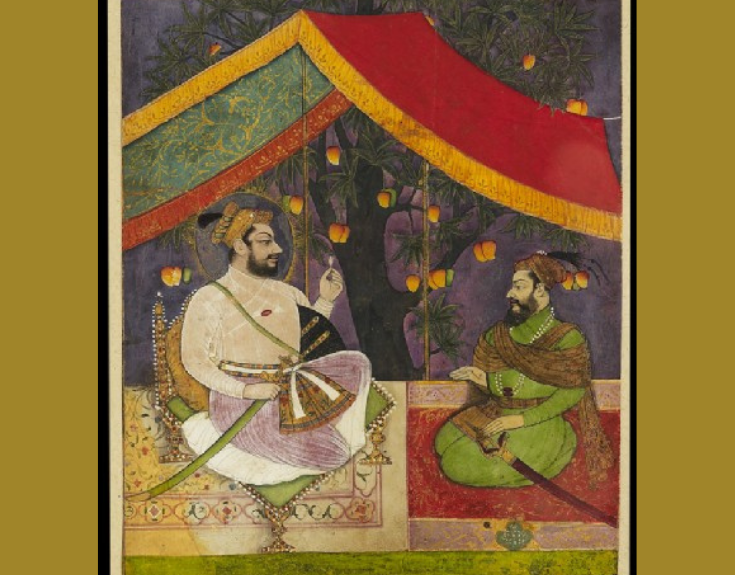
Image Credit: Sultan Ali Adil Shah sits in camp under a canopy erected beside a mango tree. Collection of the Ashmolean – Jameel Center for Islamic and Asian Art
Amir Khusrau once wrote,
“He visits my town once a year.
He fills my mouth with kisses and nectar.
I spend all my money on him
Who, girl, your man?
No, a mango.”
Planted for prosperity, mangoes found their way into our kitchens. along trade routes and in legends. They became a muse for famous poets, and formed a special relationship with the Cuckoo. Even Kalidas alludes to this in his famous play Shakuntala :
“Why, little bee, you know that the cuckoo goes crazy with delight when she sees the mango-blossom.”

This relationship with cuckoos is also mentioned in Jayadevs Gitagovinda. In fact, the vibrant fruit is an important symbol in bhakti poetry lending itself to lush spring landscapes where love blooms.
Tribal songs from Chhattisgarh and Odisha mention mango groves as sites of first love or forest rituals.

In Tamil Siddha traditions, the mango is sometimes a metaphor for spiritual sweetness or inner transformation.
In Hindu mythology, the mango tree is associated with deities like Lakshmi, the goddess of wealth, Saraswati, the goddess of knowledge, and Kamadeva, the god of love. Here, in the painting we can see Kamadeva pointing his arrow at Lord Shiva. It is said that he tipped his arrows with five flowers, one of them being the mango flower.
The fruit found its way into the Vedas as a symbol of eternal love, wealth and fertility. In the legend of Surya Bai, the beautiful daughter of the Sun transformed into a Golden Lotus to protect herself from a jealous sorceress.

Her lover, the King fell in love with the flower leading the evil sorceress to burn it. Out of the ashes a beautiful tree bearing golden fruits was born, as one ripened and fell to the ground, it transformed into Princess Surya Bai and the two lovers were reunited.