
Deep in the forest there once lived a Dhanwar and his children. His daily routine was to go out hunting and bring whatever he could to support his family. Though he used to grow paddy, Kodo, Kootki, and jawar, he had to depend mainly on his hunt.
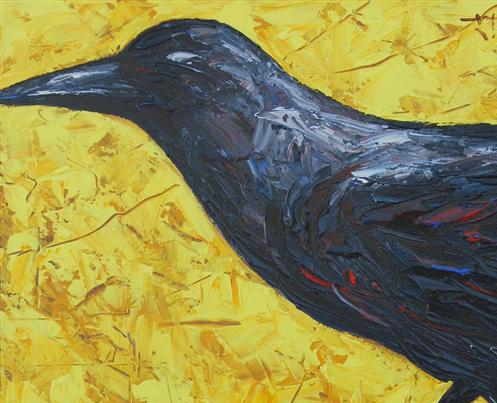
The Dhanwar had kept a crow as his pet. The crow used to fly away in the morning and used to return by dusk. As part of its habit, the crow used to visit the court of Lord Brahma. There was a neem tree outside the door of the court. Here the crow happened to sit and listen to all the proceedings of the court. On his return, the crow used to tell all the things to the Dhanwar, which he happened to hear during the day.
Once as usual the crow was sitting on the neem tree and was listening to all that was going on in the court. Brahma’s munshi, the record keeper, was taking down whatever was being spoken by his master. “This time there will be no rainfall”, said Brahma, “And there will be a famine. It shall rain only on the mountains.”
For the crow, it was the most important thing he had heard that day. He went to the Dhanwar and said: “This time the rainfall will confined to the mountains. You should therefore cultivate and sow seeds of crops on the mountains and grow whatever you wish to.”
Keeping in mind what the crow had said, the Dhanwar started making his cultivation on one of the mountains. Over time, the fields were ready. He treated them with some manure and thereafter sowed a variety of paddy. There was sufficient rainfall in the mountains, but at other places, as predicted, not a drop fell. Lord Brahma came to know about the well-grown fields of the Dhanwar.
Next year he said to his runshi: “Now there will be a greater famine. Everywhere rich crops will be destroyed by pests and insects like Dhan-Chuhka, Fafa, and Katua,” The crow heard this and conveyed it to his master. The Dhanwar was upset when he heard this, but the crow said: “The number of the pests and insects would be only one lakh”, he suggested, “If you call two lakh Chhanchhad and Maina birds then there will be no problem and your crops shall remain safe.”
The Dhanwar did as he was guided by the crow. On his invitation two lakh birds came and spread all over his fields. No sooner did the pests and insects come than they were attacked and swallowed by the birds. The Dhanwar’s fields were as green as before. They yielded a rich harvest. Again the Lord came to know about it.
The crow as usual was sitting by the side of the court of Lord Brahma. The Lord was dictating something to his munshi. He uttered: “This year there will be an unavoidable famine. Those who will transplant dry stalks of paddy shall get a good yield.” The crow heard this and passed it on to his master. The Dhanwar carried out the instructions and once again got a rich harvest.
Next year the crow heard Brahma saying that there would be one lakh rats to destroy the crops. As usual, the crow warned his master and advised him to call two lakh cats to face the trouble. The Dhanwar followed his advice. Cats, numbering two lakhs, went about in the fields and when the rats came they could get only half a rat each as their meal.
Now Brahma was again perplexed as the Dhanwar was not at all affected. He asked his munshi to record his words. He said: “Those who will not separate the seeds from the stalks in time, their crops shall not grow. Also, those who shall not use cow dung as manure shall not get any yield.” This time again the Dhanwar took care of the instructions he had received from his pet, the crow, and succeeded in getting a rich harvest.
Those who are alert, vigilant, and cautious are never deceived in times of difficulty. Success always follows them.
A Folkstory from Madhya Pradesh sourced from Folktales of Madhya Pradesh compiled by Shyam Parmar
Additional information: The Dhanwar tribe of Madhya Pradesh is an indigenous community known for their agricultural practices and deep connection to the forest. Traditionally, they rely on farming, hunting, and gathering for sustenance.
Click here to submit your Folklore.