
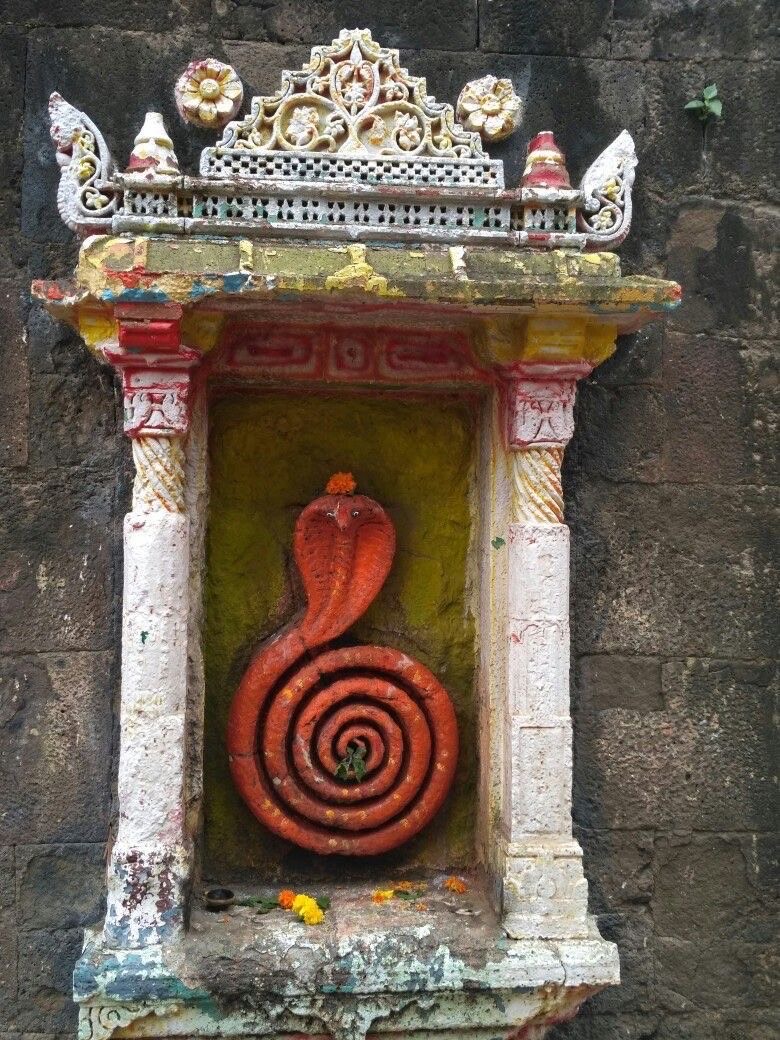
Submitted by: Ria Pillai
Heritage, for me, has always resonated with the idea of inheritance, i.e., something that is passed down across generations, it is what we choose to remember from all that once was. It is both foreign and known, as we can never be at its inception nor can we define ourselves without it.
As a Malayali who never resided in Kerala, the relation I share with my ancestral culture is one of foggy memories: traversing between slurping delicious payasam during vacation and fantasising about climbing the coconut trees in our garden like there is no tomorrow. Amidst all these futile shenanigans, one experience lingers with me across age and experience: worship at the serpent shrine in our Alleppey home.
My first glimpse was bittersweet – sour, because I was wearing sandals and didn’t realise that an army of a gazillion ants and mosquitos would be feasting on my feet, yet sugary as it was a unique variant of a temple that I’d seen. Situated among the lengthy grass, right in front of a lush tree giving shade to the Snake deities, was the rectangular altar carved out of a single rock. At first, I wondered, “Do we have our very own monument at home?”, for it seemed like the eighth wonder of the world to the nine-year-old me. What I was left with as a first impression of my cultural heritage was that of it being a mystic marvel.
It was only in my later years that I came to know that these garden snake temples or sarpa kavu, were an indicator of a Nair household – one among Kerala’s most influential communities. Yet I always wondered, why do only Nairs have these snake temples? My parents gave me a half-correct answer of them being our kula-devtas or kin-deities, it took a conversation with our local Namboodiri priest for me to unearth a wondrous legend.
The Nair caste traces its origin to the serpent demigods, who were born from the womb of Devi Kadru, the wife of Rishi Kashyapa. Post the Mahabharata war, when the heir of the Pandavas – King Janamejaya, was performing the snake sacrifice to avenge the killing of his father Parikshit (Arjuna’s grandson) from a snakebite, many of the serpents fled down south to escape persecution. These Nagas eventually married humans of the south and became Nairs. It is also believed that until a few generations ago, the Nair women would style their hair in a manner resembling a cobra hood, and even today one has never heard of a snake biting a Nair.
This legend might seem like nothing more than a fable to the rationalists, but cultural heritage by default is rooted in magic, especially if one is from India. For a community like ours, this legend serves as a mechanism that helps us cherish our ancestors and their sacrifices while recognising that the soil sheltering us is our true mother.
About Ria:
Ria is a student of Political Science and Communicative English at St. Joseph’s University and a lover of history, myth and legends.