
Storyteller: Niranjan Mondal
Collected by: Niladri Mondal
Translated by: Sharanya
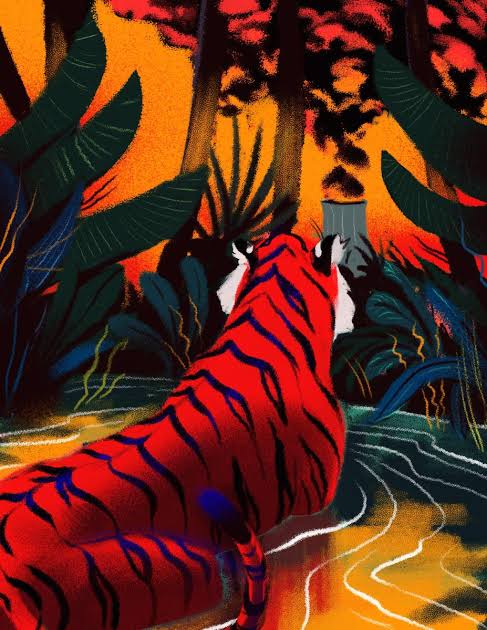
The Sundarbans, spread across the deltaic region of southern parts of West Bengal and Bangladesh, are home to Ma Bonobibi, the guardian goddess of the forest. She is revered by lower-caste Hindus, Muslims, Adivasis, and all those who depend on the forest for survival, collecting crabs, wood, fish, honey, herbs and food.
The Origin of Bonobibi
Bonobibi and her brother Shah Jangali were sent to earth to protect the poor from exploitation. They were told that in the Sundarbans lived a Brahmin named Dandroksh Muni, who ruled the region as he pleased. His son, Dakshin Rai, born of Narayani Rai, was greedy and cruel. He looted people, seized their honey and fish, and terrorised those who depended on the forest.
Bonobibi and Shah Jangali were instructed to go to the Sundarbans and protect the poor from his greed. Bonobibi asked, “Where should I take birth on earth?”
At that time there was a Nawab named Ibrahim whose wife, Phool Bibi, was childless. Though they were prosperous and ruled over large tracts of land, they remained deeply unhappy because they had no children. One day they went to the mosque and told the Kazi, “We have wealth and land, yet we are sorrowful because we have no child. Please tell us what we must do.”
The Kazi opened the Quran and, after reflection, went to Fatima Bibi, the mother of Hasan and Husain. He asked her why Ibrahim and Phool Bibi remained childless. Fatima Bibi consulted the Quran and said, “They may have children, but Phool Bibi will never be able to conceive. If Ibrahim marries again, he will be blessed with two children.”
The Kazi returned to Ibrahim with this message. When Ibrahim informed Phool Bibi, she was silent, but eventually agreed on one condition, which she refused to reveal until after his second marriage.
Ibrahim then travelled to Mecca, where he found the household of Jaleb Fakir. Jaleb’s daughter agreed to marry Ibrahim, and the marriage was celebrated with witnesses, lawyers, family and friends. After spending a few days with his in-laws, Ibrahim returned home with his new wife, Gulal Bibi.
Phool Bibi remained glum, but Ibrahim introduced the two women, asking Phool to treat Gulal like a sister. He built separate rooms for his wives and divided his time between them.
After a few months Gulal Bibi told Ibrahim that she was expecting a child. Overjoyed, Ibrahim made generous offerings to the mosque.
Towards the end of her pregnancy, Phool Bibi finally revealed her condition: Gulal had to be abandoned in the jungle. Ibrahim was shocked. “How can I exile her?” he cried. Yet bound by his promise, he went to Gulal in tears. “I have no mother, no sister, no one else in the world. Now Phool also wants to send you away. I beg you, return to your mother’s house where you will be cared for.”
Gulal agreed, and Ibrahim accompanied her part of the way. She asked him why they were leaving the road to enter the jungle. Ibrahim replied, “Before our wedding, I vowed to visit a shrine if I were blessed with a child. That shrine lies deep in the jungle.”
After some time Gulal grew tired and lay down on a cloth to rest. Ibrahim saw his chance to fulfil Phool’s demand. He covered Gulal with leaves, called her name three times, and when she did not respond, he said aloud, “O God, forgive me. I called my wife thrice but she did not answer. Forgive me for abandoning her.” He then returned home alone.
Phool Bibi was delighted to see him return without Gulal, but Ibrahim himself remained sorrowful.
When Gulal awoke and found herself abandoned, she was terrified. Seeing her plight, God sent four celestial women (hurrs) to care for her. Months later, Gulal gave birth to twins: a daughter, Bonobibi, and a son, Shah Jangali. Soon after, the hurrs disappeared, leaving Gulal alone once more.
Unable to care for both children, Gulal decided to leave them in the forest and surrender them to God’s will. She named them Bonobibi and Shajangri. As she was leaving, she encountered a deer carrying its dead fawn. The deer asked, “How can you abandon your children? Even though my child has died, I still carry her with me. As a human being, how can you show less love than an animal?”
Struck by guilt, Gulal decided to take the boy with her but left the girl to God’s care. Bonobibi, though still a child, was divine in nature. God instructed the deer of the jungle to feed her as their own.
Six or seven years passed. Ibrahim, tormented by guilt, returned to the jungle to look for Gulal. At last he found her sitting beneath a tree with their son. He begged her to return home with him, saying, “By God’s grace I have found you again. Let us return with our boy.”
At that moment Bonobibi appeared and cried out, “Brother, are you forgetting the purpose for which we were sent to earth? We were born to protect the people and the forest. Do not go with them.” She took her brother away, and Gulal fainted with grief. Bonobibi consoled her, saying, “Do not be sad. We have a higher purpose here in the jungle.”
Ibrahim and Gulal then returned alone to the islands of the Sundarbans.
Later, Bonobibi fought a battle with Narayani over the forest. After defeating her, she declared, “I will not kill you. Let us divide the land equally and live in peace.”
Dhona and Dukhe
In the village of Barijhat lived a father and son who ran a timber business. By trading in wood and other forest resources they became very wealthy. One night, the father, Dhona, had a dream in which a man told him, “You enjoy wealth built by your ancestors, who traded in the resources of the jungle. You cannot rely on your savings forever. Go and gather honey from the forest, as others do.”
Dhona called his brother Monai and said, “Let us go to the Sundarbans to collect honey. Gather men and we will go together.” They needed fifty-six men but could only find fifty-three. With the two brothers they still required one more. In search of the last member, they remembered their late friend Dukhe. They went to his house, where they met his twelve-year-old son, also named Dukhe. The boy told them that he and his widowed mother lived in poverty, struggling under debt.
Dhona rebuked him, saying, “You are old enough to work. Come with me to the Sundarbans, and I will teach you a trade and make you rich.” Dukhe’s mother was shocked, for the two men had not even attended her husband’s funeral. She refused to send her only son, but Dukhe himself was determined to go. Before he left, his mother advised him, “In the jungle lives Bonobibi, the protector of all. If you are in danger, call her and she will save you.”
The party entered the forest but found no honey. That night, Dhona refused to eat. A man asked him why, and Dhona confessed his worries about returning empty-handed. In the middle of the night he heard a voice. Dakshin Rai appeared and said, “Sacrifice the boy Dukhe to me, and you will find honey in abundance.”
Dhona was horrified. “How can I sacrifice him? He is his mother’s only son. I promised her I would care for him.” Dakshin Rai threatened him: “If you refuse, I will sink your boat and kill your men. Those who escape will be eaten by tigers.”
Dhona pleaded, “Take me or my brother instead.” But Dakshin Rai insisted, “I want Dukhe. If you sacrifice him, you will return rich and happy.”
At last, tempted by greed, Dhona agreed. Dakshin Rai instructed him to go to Kedokhali, where the trees would be heavy with hives.
Dukhe, pretending to sleep, overheard everything. Terrified, he remembered his mother’s words and prayed to Bonobibi. She appeared in his mother’s form, then revealed her true self. Dukhe fell at her feet and told her of his plight. Bonobibi assured him, “Do not worry. Dakshin Rai will not harm you. When they try to sacrifice you, I will come.”
The next morning Dhona led the men to Kedokhali. As promised, the forest was filled with honeycombs, and they collected more than they had ever seen. Dhona ordered Dukhe to stay back and cook, though the boy did not know how. Frightened, Dukhe prayed once more, and Bonobibi appeared. She prepared a meal that filled only a single vessel, but when served it was enough to feed all fifty-six men, who marvelled at its taste, saying it was like nectar.
That night, Dhona ordered Dukhe to fetch firewood. As soon as he entered the jungle, Dhona’s boat sailed away, abandoning him. Alone and afraid, Dukhe prayed again. At that moment Dakshin Rai sprang out to devour him, but Bonobibi appeared and struck him down. Shah Jangali then chased Dakshin Rai across the river and through the jungle.
In fear, Dakshin Rai ran to his friend, Gaji Kazi, and begged for protection. Shah Jangali pursued him there, and all three returned before Bonobibi. She rebuked Gaji Kazi for failing to restrain Dakshin Rai, who at last confessed and repented. He granted Dukhe seven districts of land, silver, and honey whenever he desired.
Bonobibi told Dukhe, “Your uncle lied to your mother, saying you had been eaten by tigers. She went blind with grief. Go now and care for her.” Dukhe asked, “But how can I return without a boat?” Bonobibi called Shekho the spider, her son, who carried Dukhe safely home.
There Dukhe found his mother blind and unable to hear. At Bonobibi’s guidance, he took God’s name and called to her again. She opened her eyes, saw her son, and cried with joy, “Dhona left you for the tigers, but Bonobibi saved you.” She fulfilled her vow by preparing kheer for the entire village. From that day, everyone believed in the power of Bonobibi, the eternal protector of the Sundarbans.
About Niranjan Mondal (1949- )
Why do you act? If you ask this question to Niranjan Mondal, he would reply in his characteristic unassuming yet confident tone, “The stage offers me the space to be free in a way I can never be in real life.” Since his teenage years, Mr. Mondal, a resident of Sundarban, West Bengal, has been acting in various folk-plays and yatras, a form of theatrical storytelling popular in rural parts of Bengal. He has been part of numerous productions of the ‘Bonobibi Yatra’, notably a performance at The Indian Folk Festival 2006 in Mumbai, under the direction of veteran film and theatre director Vijaya Mehta. Throughout his career, Mr. Mondal has portrayed a diverse range of characters but the pinnacle of his achievements remains his portrayal of Vivek, the inner voice. This iconic character is a ubiquitous presence in Bengali folk plays, embodying the very essence of the tradition. Vivek’s role is unique in that it discloses, through songs and dialogues, the innermost conflicts and turmoils of various characters within a play. Now in his 70s, Mr Mondal remains driven by his quest for freedom, continuing to participate in plays whenever possible.