
Book Review By Isha Tyagi
Reading folktales means to step into a realm different from ordinary life. In some ways, this realm is the same as the one you live in, but in so many ways it is not. Where the first encounters feel strange, and slowly, as one goes through the story, the strange becomes familiar? To arrive in a forest kingdom which is perpetually frozen, to live in the stomach of an old woman, to hide away one’s life force in the body of a little hornet, to witness the schemes of a talking crocodile, and the mighty courage of a one and a half finger tall human? These are the storyworlds of Thakumar Jhuli, strange yet uncannily familiar, a world of kings, queens, princes, princesses, farmers, blacksmiths, demons, and talking plants and animals. A collection of folk tales from Bengal, this text inspires its listeners with tales of triumph, bravery, and human inventiveness to turn the tide.
And yet it is a world where kings want sons, queens go to immense trouble to bear them, princes go on adventures to rescue princesses, and where trickery and cruelties abound as happily-ever-afters. Almost a hundred years later, Satabdi Das picks up the text to listen to some of its stories again, and reimagine their trajectories from the point of view of the queen, the princesses and the women in the stories.
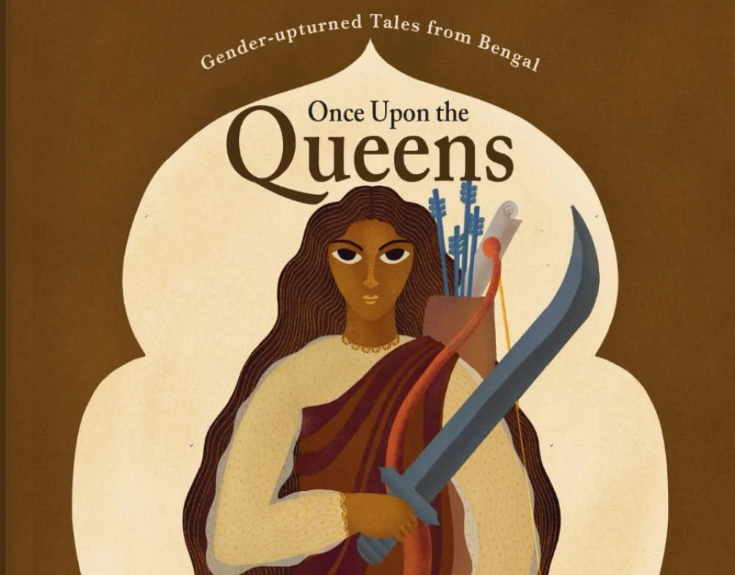
Once Upon the Queens written by Satabdi Das in Bengali and translated by Nadia Imam to English, retells a selection of stories from Thakumar Jhuli, with the purpose of centring the will and desires of the women in the folk tales, and opening up possibilities for new feelings, new ways of being and co-existence. As a reviewer, I was fascinated both by the storyworlds in these tales and by the questions and themes that emerge in a retelling that tries to play with norms of gender.
Then
The stories from Thakumar Jhuli have been told many times and spanned media forms including television, over a course of a hundred years. We often imagine folk tales as an oral tradition. Interestingly, it is impossible to talk about Thakumar Jhuli without locating it in the vibrant print culture that took over Bengal especially in the nineteenth century (Roy, 2022). Written by Dakhinaranjan Mitra Majumdar (henceforth addressed as Mitra), Thakumar Jhuli, or “Grandmother’s Bag of Stories”, has bewitched generations of Bengalis, who have grown to treasure these tales as a part of their cultural heritage. To truly appreciate the craft of Satabdi Das, it is imperative to examine what shaped the becoming of Thakumar Jhuli, as it came to be told and read across the century.
Published in 1907, the text of Thakumar Jhuli is located in a time period marked by the fervour of nationalist consciousness in the backdrop of the Swadeshi Movement in Bengal in colonial India. The call for adoption of “Swadeshi” or the “indigenous” as opposed to ‘foreign/British’ in all spheres of life did not leave the print media untouched, wherein the stories from the West were quite popular in the domain of children’s literature. With a desire to educate the urban bourgeois children with the stories and culture of Bengal, Mitra went on to collect folk stories from the Mymensingh region (Lahiri, 2022). The stories written down and anthologised by him as “Banglar Rupkatha” were intended to be an indigenous and a more desirable form of children’s literature (Roy, 2022).
How successful were Mitra’s attempts to locate and translate the Swadeshi/indigenous in the stories collected by him?
As per Lahiri (2022), while on one hand the stories create a perception of the “glorious” past of Bengal, they only do so through “distortion” and “denial” of the experiences of the indigenous that they claim to represent. This is because the project to translate Swadeshi carries the gaze of the male bhadrolok class of Bengal that constituted the intelligentsia at that time (Chakraborty, 2023). A closer look on Mitra’s stories reveals that they are mostly about the royalty figures as main characters, with a good/evil binary assigned to the royalty class versus the forest-dwelling Rakshasas (Lahiri, 2023). Furthermore, the 1907 text frames an ideal mother as the storyteller, and a young boy as a preferred audience of the folk tales, with the girl child as “conspicuously absent” (Chakraborty, 2023).
The widely different gender arcs of men/boys vis-à-vis women/girls in Mitra’s tales, with the former accorded the domain of “outer” and “activity”, and the latter confined to the space of the “inner” or the home and passivity, are neither stand-alone trends nor unique to his work. They are a part of time and discourse when nationalistic agenda was scrambling to counter the hegemonic influence of colonial rule and searching for a place to draw inspiration and a sense of self. The nationalist project at that time hinged the “Swadeshi” on the construction of an ideal woman, a bhadramahila and her responsibilities in the space of the home/the inner/the spiritual versus the outside/the materialist (Lahiri, 2022).
When calls for national pride end up delineating what women’s bodies should and should not do, children’s literature is not left untouched from becoming a political battleground.
Folk tales presented as children’s literature are intended to function as pedagogical tools to expose young children to the desired social and moral codes, and reinstill a sense of cultural and nationalistic identities as happened in colonial Bengal. The result is a veneer of an unproblematic past to instill pride in one’s culture, wherein the good-evil binary in Mitra’s tales upholds the the class and caste hierarchies, and the burden of holding the essence of nation is carved on a reductive idea of women as virtuous, passive and upholder of domestic labour.
Now
While Bengali nationalists invested in folk tales to preserve a sense of the past, authors like Satabdi Das and Nadia Imam try to explore feminist retellings to look towards a new future. With “Once Upon the Queens”, the authors attempt to reframe gender in the text to present a new storyworld for its characters, while keeping the fabric of the folk story literary tradition of Banglar Rupkatha alive.
They do not merely reverse the roles between men and women, or present a politically correct soup with no emotional mooring to the stories.
Their retelling does not treat power as a scarce resource to be grabbed and fought over for preserving kingdoms or lineages. The new text allows power to be let go, control takes a back seat, and we see a loosening up of the boundaries of the roles played by the characters.
In “The Sleeping Kingdom”, it is ultimately the act of loitering and playing in the “outside” that makes the princess unintentionally rescue an entire kingdom. In the revised “Seven Brothers Champa”, instead of conniving to kill the youngest queen, the group of queens choose compassion and co-existence over competition. Creating their own space, this story provides a glimpse of what women could be with themselves and with each other if they were not bound by the dictates of men. In “Princess Kalawati”, the two young boys Buddhu and Bhutum present masculinities that do not dominate and kill to achieve their ends, but win with their softness and kind hearts.
The good and the bad woman trope is quite common in folk tales, often masking a fear of the sexuality and agency of women. Repetition of such harmful tropes normalises how to feel about a person/group, and makes commonplace for how a society is allowed to treat them. Satabdi Roy changes these scripts and brings new twists and turns to help us imagine a world for women on their own terms. In “Shukhu and Dukhu” and “Kachanmala and Kakanmala”, she plays with the trope of good/bad girl to make way for friendships and acceptance, instead of reward and punishment, creating a new way to feel about women’s lives.
And with new feelings, new themes also emerge in the retellings. In folk tales it often occurs that male royalty figures rely on deceit to win the trust of the demons and betray them to take over their kingdom. Often in these betrayals, the Queen or the woman plays a crucial role in aiding the man’s designs. But in “The Golden Stick and The Silver Stick”, we see a shift as the princess refuses to be a pawn in the game of the men. She looks beyond the differences with demons to empathise with them and rejects the plans of the prince to betray them. The princess’s actions create possibilities for womanhood to take risks and navigate relationships with trust, instead of fear and competition.
Instead of celebrating a win by cruelty, violence and deceit, we experience a story that makes way for tenderness, freedom and co-existence with all creatures.
Moving beyond the good/evil binary, we see that there are no easy villains in the new text. Instead, it is the norms and structures of patriarchy that create conflicts, especially the brahmanical rituals that dictate and govern the lives of people in matters of sexuality, marriage and reproduction. Prescriptions to bear a son, like eating a fruit given by a priest are overcome valiantly by characters, and ultimately proved to be meaningless over the lives of people. Women navigate the system by choosing desire and negotiating agency in a web of transactions with patriarchy, as we see in the beautiful tale “The One and a Half Finger”.
Throughout the book, the authors cleverly reframe stories to point towards the strangeness of gendered norms, placing these strangenesses among the relations of power, and opening a window to a new world of living and feeling.
Seeking new images
In Once Upon the Queens, kings are still kings, queens are queens, prince and princesses alike and the world is still that of Thakumar Jhuli, a space of adventure, chaos and drama. But there is a shift in how we perceive their roles, desires, agency and to what end they drive the story forward.
Changing relationship dynamics by who takes the lead, who decides, who gets listened to, these are important questions that Satabdi tackles with aplomb. Her idea of empowerment is activity, agency and community. It is not to aggressively conquer, kill and rule with an iron hand or to betray the innocence of forest dwelling creatures. But to make space for everyone. And hence, the new folk tales give us images that were previously not there in Mitra’s tales – women exploring, loitering, taking risks, debunking useless rituals, eating heartily, befriending different creatures, and women actually leading an honest political system that really cares for people.
Can folk tales drive change?
In the current political environment, can stories retold with a feminist approach really whisk out misogyny and hatred for the “other” from readers, especially when the readers are children?
While the answer lies with how children interpret these stories, it is important that we not only need more frameworks that allow the convoluted and complicated womanhood to come to the fore, but also be wary of the danger of creating new stereotypes for empowerment, or the new good woman.
No retelling can be all perfect. But someone has to take that risk, again and again, to see what gives the futility and constructedness of gendered norms in the tales we repeat as a society. It takes a lot of effort and imagination to undo the damage and rewrite the scripts written for us by patriarchy. To tell stories that allow us to see people in all their possibilities, beyond the binaries of good and evil, requires teamwork by everyone, starting with engaging with “Once Upon the Queens”.
BIO: Isha (she/her) hails from Meerut, loves reading novels, and adores her two cats, Tara and Titli. She has about five years of experience in the development sector, working in diverse roles as a Gender Trainer, Multimedia Creator, Video Producer, Social Media Manager, and as a Legislative Assistant to a Member of Parliament.
References
Chakraborty, A. (2023, September 1). The Masculinist Construction of the National Woman and Her Gendered Practice of Love in the Colonial Bengali Fairy Tale Tradition. Feminist Encounters: A Journal of Critical Studies in Culture and Politics, 7(2), Article 21. https://doi.org/10.20897/femenc/13549
Lahiri, D. P. (2022). Thakurmar Jhuli : A Study of the Changing Bengali Society. In G. Chawla & S. Mittal (Eds.), Indian Popular Fiction: Redefining the Canon (1st Edition ed., pp. 237-252). Routledge. Retrieved August 24, 2026, from https://www.taylorfrancis.com/chapters/edit/10.4324/9781003240945-17/thakurmar-jhuli-study-changing-bengali-society-debosmita-paul-lahiri
Roy, S. (2022). Defining the Rupkatha: Tracing the Generic Tradition of the Bengali Fairy Tale. Children’s Literature in Education, 53, 488-506. https://doi.org/10.1007/s10583-021-09457-6